Imagen © Co-producción: cankarjev dom

Brainscore, 2000

  • Darij Kreuh
  • Davide Grassi

Video-documentation of the performance, 15´
Photography by Micha Fras
Courtesy of Forum  Ljubljana

BRAINSCORE is a system for incorporeal communication. Communication codes, which we developed through consideration of social aspects, are becoming old-fashioned and awkward due to increasing complexity of information technology.
While until recently the body presented some help in communication as a gestural interface, it now faces great incompatibility and apathy in transferring and mediating information. We do not refer to the body as a biological construction, which we need to redesign and accelerate to be able to keep up with techno-evolution. Rather, the body is superfluous in virtual communication environments and can easily be replaced by any virtual entity or data object. The role of a communication mediator, which has been imposed upon by an information environment, moves from the biological body to technological interfaces through semantic and functional layers. Thereby basic codes, which alter perception of communication phenomena, are changing.
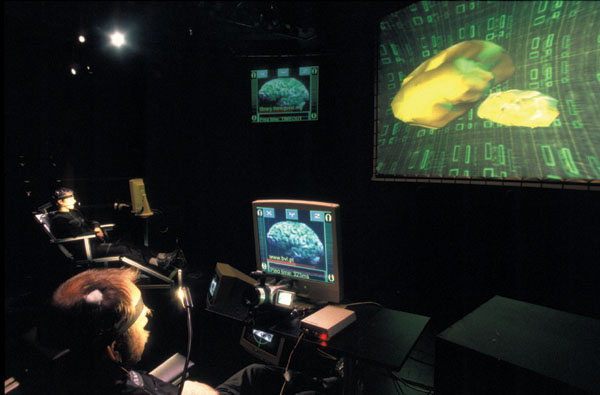
The BRAINSCORE project deals with the research of communication patterns and the interface enabling the human body and the global information space to connect. It is a performance for two operators, in which incorporeal communication is used as the starting point for creating a controlled communication system. The system is based on the use of brain waves and eye movement for performing basic commands while defining a new digital discourse in virtual space without using the traditional and generally established means of communication (thus, socially recognized and conventional communication codes are abandoned – speech, body gestures etc.).
The operators, positioned parallel to each other so that they do not face each other, establish a communication testing ground, within which they are trying to create a dialogue with the help of 3D objects.
Each operator is represented, in the space of virtual reality, by a matching transformation that embodies primitive behavioral characteristics and form, at least in the initial phase.
The operators’ task is to “educate” their corresponding representation in virtual space by performing a series of operations and commands, which are set up in direct relationship to the global net dynamics (macro) and the user’s neuronic net (micro).
The virtual space control ensues through the terminal window (the LCD monitor), which further displays how the brain is divided into five active cones. Each corresponds to one of the global themes, which can intervene with an individual. In the space of virtual reality, each of the themes is represented by a formation consisting of twenty objects. These objects represent the transformation of the basic circular form. They are based on passwords that derive from the home page of an anonymous hacker. The identity of an anonymous user in the form of a password is the carrier of the communication code and specific features like expression, colour, texture and sound. Objects, which combine into clusters according to their specific fields (meteorology, stock exchange, transport, media and epidemic diseases), represent the incorporation and influence of global migrations on the communication process between the operators. It all involves the active combination of a co-existence of the global information system and local brain activity. The community of objects thereby constitutes the alphabet, from which the changes are molded; they are composed of the above-mentioned features.
The selection of objects (and thus features, which are represented in the changes) is performed according to correspondence of the user’s features of brain patterns.
When the transformation are complete, they begin to communicate with each other in the manner that they use the data that composes them. During this phase, the characteristics of the operator’s brain patterns represent the first factor in the restriction and selection of the act of speech. The second factor is composed of the message, which is included in the second tranformation. Operators determine the degree of the transformations´ facial expressions (the percent and speed of transformation – morphing) via the terminal. They also specify the location in space and the rotation around local co-ordinate axes. All operations occurring within the terminal window are performed with the help of a system, which controls the operator’s gaze. This means that all commands are triggered at a distance, without the use of a traditional keyboard and mouse, and they restrict the activity to the mere direction of the gaze.
Visual immersion of the viewer will be enabled with the help of polarization glasses. They will be able to experience the perception of computer-generated events as the presence of reality in the spirit of the perception of the third dimension. The performance lasts approximately 30  minutes.


Programming by Tadej Fius
Eye movement tracking system: Iztok Lapanja
Producer:  Eva Rohrman
Production: FORUM  Ljubljana, 2000

more information